What Are the Five Elements—Metal, Wood, Water, Fire, and Earth?
Modern physics suggests that the energy of matter can be represented by frequency. Therefore, we believe that the Five Elements may represent five different categories of energy and frequency.
Understanding the Five-Element System
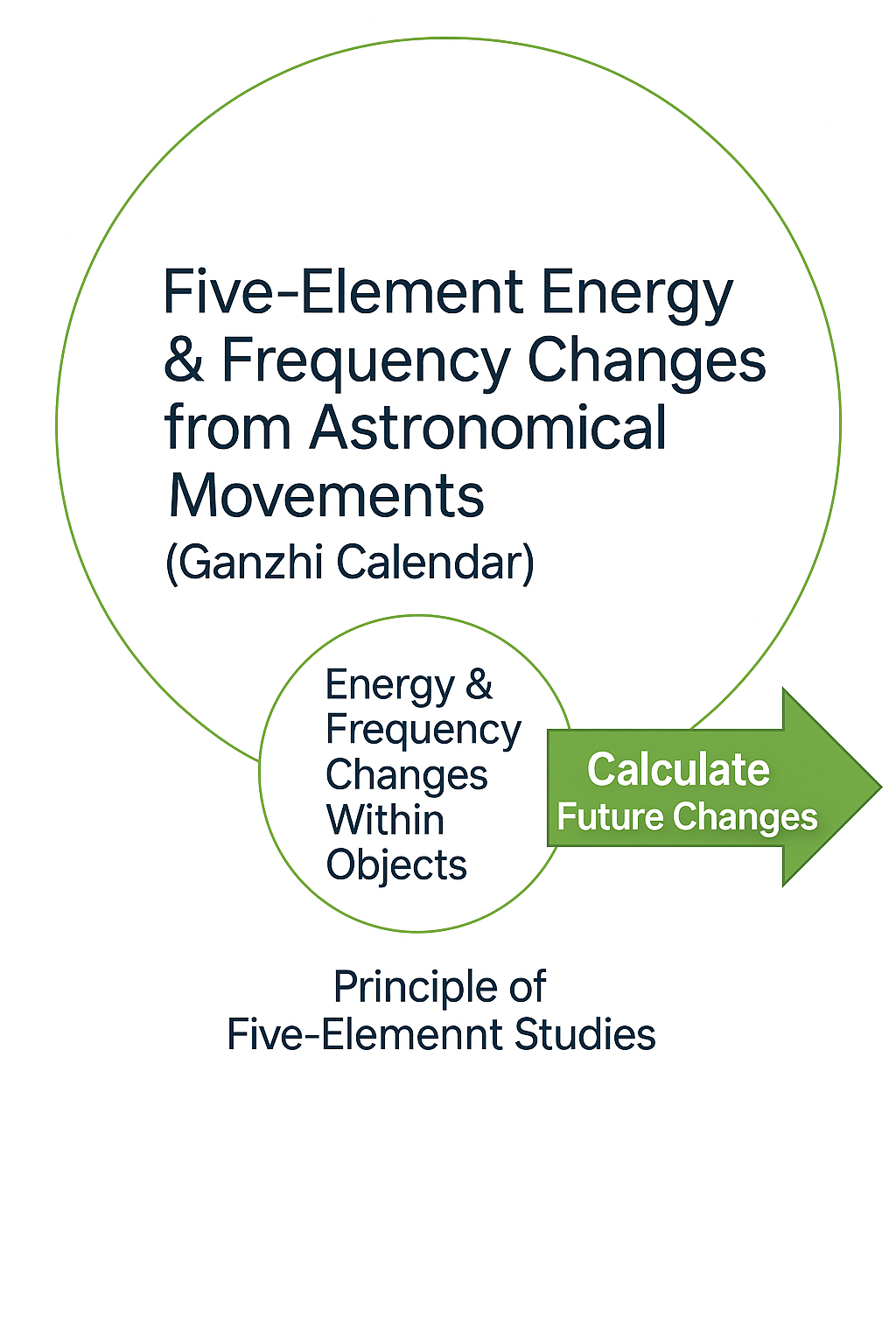
The Five-Element system expresses the changes in environmental energy and frequency on Earth caused by astronomical movements using the Ganzhi calendar. At the same time, it measures the energy and frequency of objects through technical methods. These two sets of frequencies—external cosmic energy and internal object energy—are then calculated together through Five-Element formulas to derive the developmental outcome of the object.
This is the framework through which we understand the Five-Element system.
The Principles of Five-Element Studies
Energy and Frequency Changes from Astronomical Movements
The Five-Element Ganzhi calendar is an ancient Chinese system that reflects astronomical motion. Month branches, hour branches, and the 24 Solar Terms accurately correspond to the Sun's apparent north–south movement (Earth’s revolution) and the alternation of day and night (Earth’s rotation). Year branches correspond to Jupiter’s twelve positions along the ecliptic.
Energy and Frequency Changes Within Objects
Classical I-Ching techniques provide multiple methods to detect the internal energy frequencies of objects. When combined with the external energy frequencies derived from the Ganzhi calendar, the results yield measurable calculations. This forms the core technical principle of Five-Element studies and I-Ching methodologies.
How Do We Experimentally Verify the Accuracy of Five-Element Studies?
This is a central focus of Tianji Academy's research. In ancient China, tools such as reed-ash blowing were used to detect the precise timing of Solar Terms and their Five-Element attributes, but these early techniques produced notable errors. Modern frequency-detection technologies—such as spectral detection and invisible-frequency analysis—are far more precise, yet instruments for measuring the invisible frequencies associated with the Five Elements still do not exist.
To establish a reproducible measurement method, we use financial candlestick charts (K-line charts) as observable, quantifiable, and standardized frequency measurement tools. By conducting large-scale experiments and statistically comparing K-line results, we attempt to verify and refine the Five-Element calculation equations and improve the overall precision of measurement.
Since 1999, we have conducted experiments across stocks, futures, and forex markets, accumulating over ten thousand data samples and developing an online data platform for research. With sufficient data, we carried out six years of real trading verification—thousands of trades annually—and have achieved preliminary validation results.
How Can Five-Element Studies Develop Scientifically?
Compared to modern scientific research standards, the current scale of experiments and datasets is still limited. In the coming years, our main objective is to increase capital allocation for real-market experiments and expand the research scale.
We will further build modern academic and laboratory systems, welcoming teachers and students who share the same vision to participate in learning, experimentation, and research. This collaborative foundation is essential for the scientific development of Five-Element studies.
We aim to develop Five-Element studies into a true scientific discipline and contribute its value to human knowledge and technological advancement.